Posts

The Shallows (Ps. 90 & Luke 16)

My quiet time yesterday brought me to Psalm 90 written by Moses in the desert, and it found me again today as I opened my Bible to study Luke 16. I came across a phrase of Sproul’s in his commentary about Luke 16:19 about the shallowness of man’s repentance (at best) and it tumbled the two readings together for me. If you aren’t a poetry reader, feel free to skip past it, but if you want to read it, FIRST read Psalm 90 and Luke 16:19. Then it might make a fraction of sense. -------------------------------------------------------------------------------------------------------------------------------- The Shallows Once again, I wade through the shallows Feeling cleaner than I was before I stepped in, Yet still lacking (without knowing my lack)  The fulness of repentance, The bliss of completely turning my back to my sin Instead of trying to cleanse myself  And feeling better about it for a little while. This holding on is not letting me go.  LORD, be my dwelli...
A Woman's Considerations (based on Jer. 9:20-24)

If I could lock the doors to death, I would, yet even then it might creep through the windows, unstoppable, invading the sanctity of my home to steal any security I might possess. Like a thief, death is determined to enter, circling my home to find a way around my desire for life and the tenacious hold I have on it. Like a virus, it stealthily creeps inside, unseen, penetrating the fortress of skin and bone and wearing me down as I sit here thinking myself safe. Like an invading army sent by God to discipline stubborn necks held stiff, unrelenting, death steals the joy and peace I tried to make for myself. The threat of death,  the eternal, irredeemable nature of it convinces me to listen, to evaluate the security I thought I possessed. I hear the prophet boldly speak God's terrifying words, and seeing his zeal, I alone stop to listen and believing him,  I repent and live. When Death knocked, he took no prisoner in my home;  instead he found God with me  and moved to...

Forgotten Highways (Jer. 6, 12, 17, 18; Ecc. 1:9)

I always loved Robert Frost’s poetry, and I’d dare say many if not most Americans are familiar with his poem “The Road Not Taken,” as it is often taught in both middle and upper school curriculums. Possibly it is the imagery that sticks with us, and some might even envision themselves forging off into a path not already trodden down or beaten by the footsteps of life, even though Frost in his poem says that the two paths are equally worn. I commented to my husband the other day while riding in the woods that I wanted to come back when there was some fall foliage and take a picture at the place where the two roads divided because it made me think of the poem. It just sticks with you. It's evocative. The thing is, the more times I taught the poem and the older I got, especially knowing what I now know of Frost from researching and then teaching his background before reading his works, the more I doubt what I thought I used to know about the poem.  Reading poetry is not like reading ...

Old Men Don't Run (Luke 15; Is. 6; Deut. 21; Rom. 2:4)

The will to get up came after the ruin (Luke 15:14).  He knew he was in troubled when he wished to eat what he was feeding the pigs and couldn’t. The work, this hunger for even the swill to fill his empty stomach . . . the sudden clarity of realizing where he was and whose he was, of realizing the scope of his sin—not just against his father, his older brother, himself, but most of all his sin against heaven itself, against God the Father. Like Isaiah, whose vision of God was seen in the temple (Is. 6:1-5), he too saw a vision, but his came looking up from the bottom of the swine pit. Instead of an absolutely terrifying vision of God in all His glory, this young man looked around and saw his own ruin because of choices made, his lack of worthiness to be called a son after his rebellion against the loving father who had reared him. He literally was a man of unclean lips living among a people of unclean lips. He, too, saw the horror of his sin. However, his sin was no bigger tha...

The ILLogic of Worry (Is. 26; Ps. 139)

Image
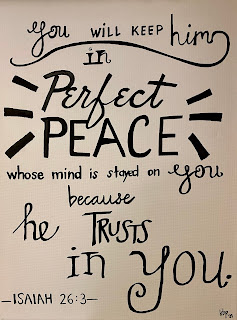
In perfect peace . That's how I want to live as a Christian. That's how I am supposed to live, daily trusting in His power to save me spiritually, to preserve me and help me persevere, to keep me physically, to take me home when this life is over.  The reality is that I often let my heart be troubled. The reality is that is doesn't have to be. The gap between those two is the problem. It is at that point I have imperfect peace .  The past few weeks have been a study in being illogical for me; it was a test, and I am pretty sure that for a good portion of eleven days I failed somewhat miserably. The test shouldn't have been unexpected. I have been reading, teaching, and speaking of this quite intensively, about trusting in the Lord, for the past few months. Elijah's departure from trust after seeing God whack 400 false prophets; the kings of Israel and Judah and their issues with trust when surrounded; the writing about trust in my last few posts; the encouraging of...

The Problem with the World (Hosea 6; 2 Chron. 13-18; Ps. 56; Hosea 8-14)

Image
An old song from my favorite album by Downhere released in 2008  has been on my mind this week. If you've never heard it, listen to it above, and note the lyrics. They're still timely and true in today's troubled world. To my knowledge "The Problem" didn't win any awards and was never released as a single. It's a little too "in your face" to win awards in our modern world, just a  little  too offensive. When I listen to it, it still pokes and prods at me and forces me to stop and think about myself before I go blaming all the problems I have on the world in which I live. "The problem with the world is me" pretty much sums it up. I have serious issues! (Ask my husband, Greg; he lives with me. :)  As I continue reading through the Old Testament in my quiet time each morning, a common refrain keeps popping up this time through the Bible. Who or what am I trusting in? Is it a government to deliver me from a broken economy, from lawlessness...

Fresh Springs (Heb. 3; 2 Chron. 14-16; Eph. 6)

Image
Humans tend to worry, especially my particular variety, female. I fully know that my lack of trust in God in all things at all times is sin (unbelief), but when I am caught up in a moment of worry, it can be difficult to be objective and see I am accomplishing nothing, but rather steeping myself in fear and doubt. The older I get and the more I read the Bible and let it truly seep into me, the more I become aware of the necessity of completely trusting God at all times, and the more I recognize when I have failed to do so. The writer of Hebrews 3:12-13 warns me:  Take care, brethren, lest there be in any of you an evil heart of unbelief leading you to fall away from the living God. But exhort one another every day as long as it is called today that none of you may be hardened by the deceitfulness of sin. Sin is deceitful. The heart is deceitful. Apart from Christ and His Spirit in me, I cannot even recognize that I am petting the unbelief in my heart. The thing is, more th...

Things I Shouldn’t Seek (2 Chron.; Rom. 12:19; Matt. 6:33)

Solomon was equally the wisest and most foolish man who ever lived. In asking in humility for the wisdom and knowledge he needed to guide the people God had made him king over, he was granted that plus riches and wealth and honor unlike any other king before or after him. This wisdom is easy to see, but the foolishness might seem hidden at first glance. He ruled with much wisdom for 40 years, saw peace rest on his kingdom, and built a temple gloriously unparalleled, yet he started following other gods, and his heart eventually strayed from the one true God. He had everything, yet it wasn’t enough, and that is foolishness. It is from Solomon’s foolish actions after he received God’s gifts that we can learn what to avoid, and it is from God’s words to Solomon when he asked for wisdom that we can learn things we shouldn’t seek after.  The first and second thing that God mentions Solomon not asking for are riches and wealth (2 Chron. 1:10). It has always seemed strange to me that bot...

Emphatical Utterances (Luke 12:49-50)

Image
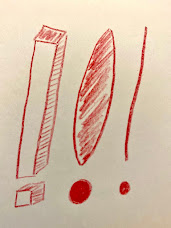
Exclamation points as punctuation marks (formerly called ecphonemes , a now-defunct word) did not exist in print until well into the 1400s. Before then writing tended to run together and made text difficult to understand and interpret, although different methods of separation of words had been in use by then. There is some confusion over where the exclamation point originated, but there is one theory that says Latin monks invented it by writing expressions of joy, essentially a hurray as  lo . The way in which they did so eventually became a line over a dot instead of a line next to an o, and voila! our now much-debated punctuation mark was invented. Another claim comes from a 14th-century Italian poet, Iacopo Alpoleio da Urbisaglia, who wrote Ars punctuandi (The Art of Punctuating), only he called his version of the mark an “admiration point.” Regardless of what it is called and when it originated and who gets credit for it, the mark seems here to stay. The mark has been around...

The Sacrifice of Fools (Ecc. 5; Ph. 4:8)

Proverbs and Ecclesiastes, books full of wisdom, offer a challenge to me every single time I read them. I read and find my own foolishness, and if I am in a judgmental mindset, which I admit I fight (less now than I used to), I find others’ foolishness, too. Often it is easier to see someone else’s foolishness than my own, and there’s the rub. Seeing my own foolishness and taking action against it instead of seeing it and being content to leave it be or seeing it and having a hopeless attitude.   God did not give me wisdom in his word for me to squander. Lately I have been thinking about two things that are foolishness in my life: talking too much and dwelling unduly on the days of my life. (Yup, you guessed it. I’ve been reading in Ecclesiastes). I DO like to talk, but at the same time, my alter ego is very quiet. I can ride three hours rattling off words or ride three hours speaking absolutely none. My flesh wants to talk when it wants to talk, i.e., when I am not reading o...