Posts

Fresh Springs (Heb. 3; 2 Chron. 14-16; Eph. 6)

Image
Humans tend to worry, especially my particular variety, female. I fully know that my lack of trust in God in all things at all times is sin (unbelief), but when I am caught up in a moment of worry, it can be difficult to be objective and see I am accomplishing nothing, but rather steeping myself in fear and doubt. The older I get and the more I read the Bible and let it truly seep into me, the more I become aware of the necessity of completely trusting God at all times, and the more I recognize when I have failed to do so. The writer of Hebrews 3:12-13 warns me:  Take care, brethren, lest there be in any of you an evil heart of unbelief leading you to fall away from the living God. But exhort one another every day as long as it is called today that none of you may be hardened by the deceitfulness of sin. Sin is deceitful. The heart is deceitful. Apart from Christ and His Spirit in me, I cannot even recognize that I am petting the unbelief in my heart. The thing is, more th...
Things I Shouldn’t Seek (2 Chron.; Rom. 12:19; Matt. 6:33)

Solomon was equally the wisest and most foolish man who ever lived. In asking in humility for the wisdom and knowledge he needed to guide the people God had made him king over, he was granted that plus riches and wealth and honor unlike any other king before or after him. This wisdom is easy to see, but the foolishness might seem hidden at first glance. He ruled with much wisdom for 40 years, saw peace rest on his kingdom, and built a temple gloriously unparalleled, yet he started following other gods, and his heart eventually strayed from the one true God. He had everything, yet it wasn’t enough, and that is foolishness. It is from Solomon’s foolish actions after he received God’s gifts that we can learn what to avoid, and it is from God’s words to Solomon when he asked for wisdom that we can learn things we shouldn’t seek after.  The first and second thing that God mentions Solomon not asking for are riches and wealth (2 Chron. 1:10). It has always seemed strange to me that bot...

Emphatical Utterances (Luke 12:49-50)

Image
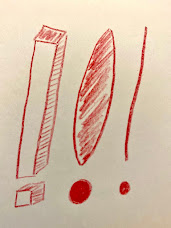
Exclamation points as punctuation marks (formerly called ecphonemes , a now-defunct word) did not exist in print until well into the 1400s. Before then writing tended to run together and made text difficult to understand and interpret, although different methods of separation of words had been in use by then. There is some confusion over where the exclamation point originated, but there is one theory that says Latin monks invented it by writing expressions of joy, essentially a hurray as  lo . The way in which they did so eventually became a line over a dot instead of a line next to an o, and voila! our now much-debated punctuation mark was invented. Another claim comes from a 14th-century Italian poet, Iacopo Alpoleio da Urbisaglia, who wrote Ars punctuandi (The Art of Punctuating), only he called his version of the mark an “admiration point.” Regardless of what it is called and when it originated and who gets credit for it, the mark seems here to stay. The mark has been around...

The Sacrifice of Fools (Ecc. 5; Ph. 4:8)

Proverbs and Ecclesiastes, books full of wisdom, offer a challenge to me every single time I read them. I read and find my own foolishness, and if I am in a judgmental mindset, which I admit I fight (less now than I used to), I find others’ foolishness, too. Often it is easier to see someone else’s foolishness than my own, and there’s the rub. Seeing my own foolishness and taking action against it instead of seeing it and being content to leave it be or seeing it and having a hopeless attitude.   God did not give me wisdom in his word for me to squander. Lately I have been thinking about two things that are foolishness in my life: talking too much and dwelling unduly on the days of my life. (Yup, you guessed it. I’ve been reading in Ecclesiastes). I DO like to talk, but at the same time, my alter ego is very quiet. I can ride three hours rattling off words or ride three hours speaking absolutely none. My flesh wants to talk when it wants to talk, i.e., when I am not reading o...

Looking at Prayer a Little Differently (Pro. 12)

Recently, after a friend asked me about it, I purchased and have been reading through (and praying through) Matthew Henry’s A Method for Prayer: with scripture-expressions, proper to be used under each head . Yes, it is archaic; yes, it is awkward to read, especially out loud as prayers; yes, even its subtitle is offensive to this world in which we live (much less its content true to the Bible and politically incorrect); however, praying through this book has been teaching me valuable lessons. While I’ve known that scripture can be/may be/should be prayed, I confess that in the past, I have done it very little. Even thinking about praying using the words of the scripture seemed awkward. This has been my loss. I find that there is little more comforting than knowing that my prayer is uncorrupted because I am using His words. My will is easy to far too easy to pray, but sometimes knowing what to pray and how to pray it is hard for my human flesh to grasp. His Spirit speaks through His Wo...

Dear Older Me

For several years while teaching, I had my seniors write letters to themselves to about the things they wished they had known when they started high school. There was nothing original in this idea, but it was inspired by the song “Dear Younger Me” by Mercy Me. Each year when I gave this assignment, my seniors would start off scoffing the idea, and some never took it seriously, but the ones who did found they had already learned much during their four-year journey through high school, and they extended this wisdom to others because they took it seriously.  Today while reading chapter three of Proverbs, I came across the title, “Guidance for the Young,” and thought of that exercise. Almost immediately I did a little scoffing myself and thought of how many times I’ve read this chapter before. Then I really read it and ingested it, and found myself in need of writing a letter to future me, lest I forget what I have already learned and need chastening again later. Dear Olde...

Sinning Against the Remedy (Ps. 2)

In my morning reading, I find myself in a section of 1 Chronicles and Psalms, as the Chronological Study Bible places Psalm 2 (penned by David ) with Solomon’s ascension to the throne. We have already studied Psalm 2 in our Wednesday night sessions at church this year, but as usual, the Word of God is alive and applies the scriptures I read to my heart on a daily basis. Hebrews 4:12 reminds me of this: “The word of God is living and active and sharper than any two-edged sword, and piercing as far as the division of soul and spirit, of both joints and marrow, and able to judge the thoughts and intentions of the heart” (NASB). Psalm 2:10-12 speaks not only to kings to be wise as they judge the earth but also to the rest of mankind, to me as both kings and ordinary people will stand before the throne of God.  Verses 11-12 particularly spoke to my heart today: “Serve the LORD with fear and rejoice with trembling. Kiss the Son, lest He be angry, and you perish in the way when His wra...

Who then is the faithful and sensible servant? (Luke 12; Jn. 21)

Digging into God’s Word and discovering its treasure brings me much joy. I love seeing something I haven’t seen before or often, if I am being honest, seeing something I’ve seen and forgotten only to uncover it again, a treasure unearthed. But new connections are the best! In digging in today in preparation for continuing through Luke with the ladies on Thursday evenings, I found a passage in Luke 12 that reminded me of Jesus speaking with Peter on the beach in John 21.   In Luke 12, even though He’s in the midst of a great multitude of people, Jesus’ audience is His small group of disciples, these who will soon truly understand what it means to trust God to provide for them in all situations at any cost. He is teaching them to: Beware of hypocrisy! All will eventually be known and revealed (v. 2-3); sooo . . . Fear God who judges the soul and values His creation, rather than men who can only hurt their bodies (v. 4-7). Boldly proclaim the name of Jesus before men lest th...

Don’t Miss the Point (1 Sam. 28)

Recently, some friends and I were discussing Saul’s experience with the medium in I Samuel 28. I had never really thought about the chapter being controversial or having different interpretations but rather had read it as an indication of the depravity of Saul’s heart and his desperation to escape judgment that was surely coming to him. Yet apparently, the argument had been presented in a previous discussion that Samuel (as called up by the medium) wasn’t really Samuel but an evil spirit, and they were asking what I thought. It had never occurred to me, as I have read the passage in a very literal sense each time I have encountered it, seeing only what it reveals about Saul and his heart   By the time this incident occurs in Saul’s story, he already knows that the LORD has rejected him from being king over Israel because of the disposition of his heart, his open disobedience and rebellion. Earlier in the book, Samuel had spoken to Saul these words: “Rebellion is as the sin of divi...

Hallway Meditations (1 Sam. 12)

Image
I’ve had the unusual experience of going back over the last two months. Going back to where I was before the Lord moved me. Going back to the bustle of the classroom. Going back to what I had willingly left behind because there was a need. Admittedly, it has been a challenge and a distraction. And now I find myself eagerly waiting. Waiting to be released after helping to transition a new teacher into the position I was temporarily (and somewhat reluctantly) holding. Waiting to go back to my “normal” life. For now just, well, waiting. That meme that has made the rounds the past few years about waiting in the hallway for God to open the next door? That has been me this week.  While I’ve been waiting, I’ve continued reading and studying, the difficulty of which you might not understand unless you’ve ever been in an upper school hallway for any extended amount of time. Older people might remember rooms that quieted with the bell and the teacher’s roll call, but that is rarely the ca...